Contextual Background
In this case study, I reflect on two Level 4 modules across UAL’s Computer Science degrees. The first module is the “Introducing Computer and Data Science module” (IC&DS), which teaches introductory programming skills. The second is “Introducing Human-Computer Interaction” (HCI) which is more design skills based. I reflect on two issues relating to student diversity in the classroom and consider ways to differentiate (Eikeland and Ohna, 2022) learning accordingly: diversity of technical skills and diversity in hyposensitivity.
Evaluation
:::DIVERSITY OF TECHNICAL SKILLS:::
In IC&DS, students join from a variety of backgrounds and have varying levels of starting programming skill. My pre-course survey captured in week 1, for example, shows that ~75% of the students were unfamiliar with the technology we were teaching, but ~25% very familiar. I observed that this impacted levels of engagement in the class. Course feedback from student reps also reflected discussions with stronger students wanting to engage in more complex programming tasks, already largely familiar with the basics.
::: DIVERSTIY IN HYPOSENSITIVITY :::
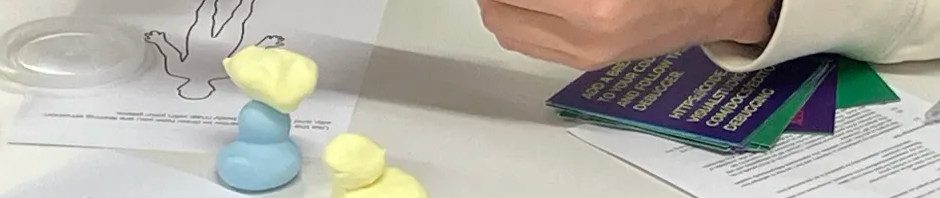
One of my HCI lectures focused on using sketching and low-fidelity prototyping skills to explore design. I had run several, fast-paced mini-tasks. For example, seeing an image of some software and having 1 min to sketch it, or to create a paper prototype of a watch in limited time. I even added music for them to create to and felt that the students overall demonstrated lots of energy, were in continually conversation, and overall had a fun learning experience. However, at the end of the session, one student came up to me saying that the found it difficult to focus during the lesson, that there was a lot going on, and that they preferred quiet time where they could look at materials in a more independent way to observe and take in the content.
Moving Forwards
Moving forwards, I want to employ more strategies for differentiating my teaching practice. On technical skills, I had offered more difficult extension tasks to students in the class but found that many students simply ignored the extension task – comfortable in having completed the minimum required for the course. In future, I believe that exploring more intrinsically motivating project-based tasks for students to continually build their own skills would be beneficial cf. Pucher et al. (2003). I also want to explore more individualistic approaches to supporting students, to ensure that students are rewarded for increments on their skills. I’ve been reading about ipsative learning approaches (Gwyneth Hughes and Kitagawa, 2014), where baselines for students are established and assessment builds on their current skills. In particular, I want to discuss this next time I meet with course leaders to ensure that ipsative learning could occur as student’s progress at each degree level – for first-year students it’s hard to establish the level of their prior learning (ibid.).
Regarding diversity in hyposensitivity and hypersensitivity (Stevens and Stegemann, 2016), I tried to organise future sessions so that students could use both classroom and its communal areas. Students preferring a quieter atmosphere would be able to find a quiet space to nurture their learning, whilst students who need more stimulation could decide to stay in the busier environment. I plan to follow up with students later to identify whether this approach has been effective. Here, I also want to explore more sensory modes of learning e.g. (Sensory Studies, 2025).
References
Gwyneth Hughes, E.W. and Kitagawa, K. (2014) ‘Use of self-referential (ipsative) feedback to motivate and guide distance learners’, Open Learning: The Journal of Open, Distance and e-Learning, 29(1), pp. 31–44. Available at: https://doi.org/10.1080/02680513.2014.921612.
Pucher, R.K. et al. (2003) ‘Intrinsic motivation of students in project based learning’, Transactions of the South African Institute of Electrical Engineers, 94(3), pp. 6–9.
Sensory Studies (2025) ‘Sensory Studies’. Available at: https://www.sensorystudies.org/.
Stevens, N. and Stegemann, K.C. (2016) ‘Curriculum Planning: The Need for Sensory Regulation Methods in Initial Teacher Education Programs’, Teacher Capacities: Knowledge, Beliefs and Skills, p. 569.